An outage reserve and a scheduled discharge make claims on the same battery budget. Promising an evening contribution while preserving standby energy requires an allocation that can accommodate both duties. The choice between 225 kWh and 257 kWh consequently depends on what remains available after reserve requirements are respected. A larger nominal capacity changes that budget, while the operating plan determines which part can be spent during normal service.
Allocating Stored Energy Before Scheduling Discharge
Standby energy remains available for a contingency, whereas routine dispatch deliberately releases energy during ordinary operation. Assessing all-in-one hybrid energy storage systems requires these allocations to remain distinguishable. Energy assigned to backup cannot be counted again as freely available for a scheduled discharge unless a credible recharge restores it before the required standby period.
State of charge describes the battery’s charge level relative to its reference capacity. The permitted lower operating limit establishes one boundary; a standby allocation can hold additional energy above that limit. With a given upper charge level, raising the retained reserve reduces the window available for routine use.
For illustration, allocating 50 kWh of a nominal 225 kWh budget to standby leaves 175 kWh before other restrictions and losses. The same illustrative allocation within 257 kWh leaves 207 kWh on that nominal basis.
These calculations explain the allocation only; they do not prescribe a reserve setting or establish delivered AC energy. A project reserve instead follows the retained load and its required duration, with the permitted charge range applied to the configuration.
Timing gives that reserve a practical meaning. A facility requiring protection throughout business hours faces a different allocation from one retaining energy only for a defined overnight period. The operating plan has to state when the reserve is required, since an expected future charging opportunity does not establish that the energy is available now.
Comparing the Two Cabinets on Equal Terms
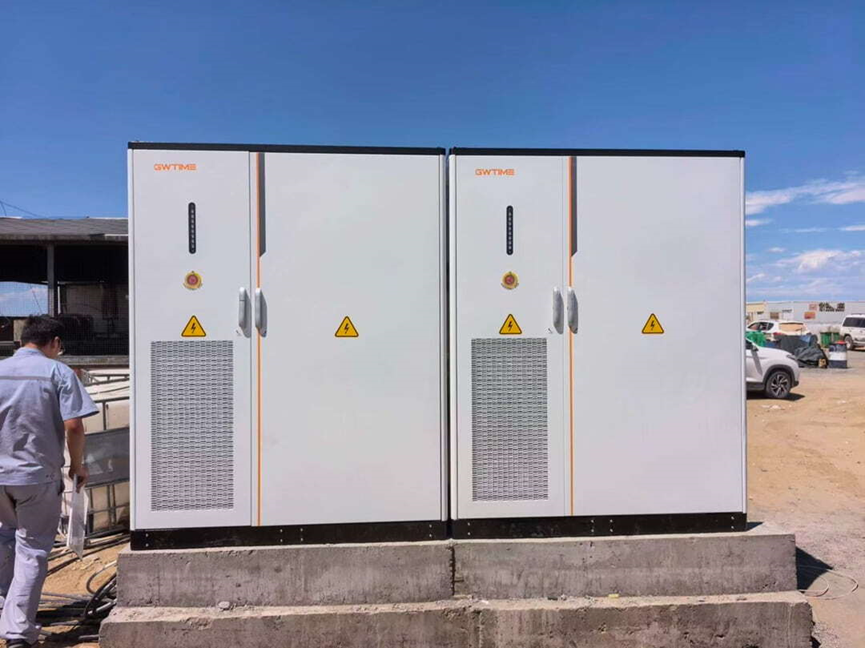
A specified standby energy allocation occupies a different share of the 225 kWh and 257 kWh capacities in the GWTime 125 kW family. Both versions retain 125 kW AC output. With equal starting charge fractions, a scheduled withdrawal leaves different nominal energy balances in the two versions, subject to the same continuous output limit.
The 225 kWh configuration is identified as GWESTS125-225kWh-400-A. The 257 kWh version is GWESTS125-257kWh-400-A. Both use 314 Ah LFP cells, smart air cooling and an IP54-rated cabinet. Evaluating them under comparable operating conditions keeps the comparison centred on energy allocation, rather than treating the increase in nominal capacity as a change in the system’s intended purpose.
Physical accommodation differs alongside capacity. The identical 1600 by 1050 mm footprint keeps width and depth constant, while the 257 kWh version requires 2300 mm of height and has a 2700 kg mass. Its 225 kWh counterpart stands 2050 mm high at 2400 kg, so placement planning includes vertical clearance and physical support.
Reading the Nominal Discharge Window
Before any energy is withheld, dividing the two capacities by 125 kW produces approximately 1.8 and 2.06 hours respectively. Those nominal figures assume the stated power throughout the period. They describe a mathematical starting point, rather than the hours available after a standby allocation and the actual operating conditions have been applied.
The operating estimate for these GWTime configurations retains reserved charge, permitted depth of discharge, efficiency, temperature and protection limits. Comparisons of all-in-one hybrid energy storage systems then concern the usable window for the assigned duty. A changing load requires a dispatch curve rather than a constant-power shortcut.
Reserve allocation can also change during a sequence of operating periods. An early discharge may reduce what is available for a later peak, while a subsequent charging interval may restore part of the budget. The calculation follows those events in order, retaining the charge available when each commitment begins.
Recharging is a scheduled energy movement with a source and a duration. Its contribution to the next reserve depends on permitted charging power and the source power available alongside concurrent site loads. A recovery period entered on a schedule consequently needs an explicit source-and-load balance.
Choosing Capacity from the Combined Duty
A proposed discharge curve can reach the standby threshold before its scheduled duty is complete. That intersection identifies where the routine commitment would begin consuming protected energy. Adding usable capacity, shortening the routine discharge or revising the stated reserve are different responses, with the last changing the original standby promise itself.
Fifteen- or thirty-minute demand records requested for the GWTime 125 kW system provide a basis for estimating energy above a proposed peak-shaving target. The intended critical-load operating period supplies another part of the capacity decision. Neither a monthly electricity total nor the largest connected machine establishes both allocations.
The larger version becomes relevant where the smaller usable window cannot cover the combined duty under the applicable conditions. Where both allocations already fit, additional nominal capacity does not by itself establish a necessary operating benefit. The choice remains attached to the reserve and scheduled energy actually required.
Both duties have to fit within one permissible energy window. A comparison of all-in-one hybrid energy storage systems is resolved by the specified standby commitment and discharge schedule, together with the installation conditions. The chosen capacity must leave the promised standby energy intact at the end of the planned daily discharge.
